Understanding the Thunderstorm Warning System
18 June 2026
LEUNG Yu-ting, CHUNG Yan-wa, LAM Sam-yi
Entering summer, warm and moist air masses approach the coast of Southern China under southwesterly winds, warming the atmosphere and creating conditions favourable for convection development, leading to severe convective weather such as thunderstorms. Hong Kong records an average of over 16,000 cloud-to-ground lightning strikes annually. Thunderstorm activity is frequent and common, and the associated safety risks should not be overlooked. The Hong Kong Observatory's thunderstorm warning system is crucial for safeguarding public safety during outdoor activities. This article will briefly describe the characteristics of thunderstorm development, introduce the Thunderstorm Warning, and explain the Observatory's lightning nowcasting services.
Thunderstorms Develop Rapidly; Cloud-to-cloud Lightning Also Warrants Caution
On fine days, ample sunlight causes ground temperatures to rise, making the atmosphere unstable and favourable for convections. If other conditions are present as well, such as surface trough, sufficient moisture, and high-level divergence, vigorous convections can trigger severe convective weather accompanied by thunderstorms. Thunderstorms triggered by high temperatures develop very rapidly, sometimes it is sunny in the morning, but showers and squally thunderstorms occur in the afternoon.
The most common types of lightning are cloud-to-ground lightning and cloud-to-cloud lightning. The former is lightning discharge between a cloud and the ground, posing threats to people and facilities on the ground. The latter is the discharge within the same cloud or between two separate clouds, which does not pose a threat to life and property on the ground. However, cloud-to-cloud lightning also indicates an extremely unstable atmosphere and is an important indicator of a mature thunderstorm system. Cloud-to-cloud lightning sometimes occurs before cloud-to-ground lightning. Therefore, when lightning is frequent in the sky, even if thunder has not yet been heard or showers have not yet been seen, members of the public should be on the alert immediately, seek shelter indoors as soon as possible and avoid outdoor activities.
A Brief Introduction to Thunderstorm Warning
Thunderstorm warnings issued by the Hong Kong Observatory are intended to give short-term (within one to a few hours) notice of the likelihood of thunderstorms affecting any part of Hong Kong. When inclement weather comes with thunderstorms, the Observatory will also mention information about violent gusts, hail, waterspout, and tornado in the Thunderstorm Warning. Once the warning has been issued, the warning is broadcast over the radio and television, and announced on the Observatory's website, the “MyObservatory” mobile app and the Dial-a-Weather system (1878200).
For isolated thunderstorms, the warning issued by the Observatory will indicate the regions that will be affected during the warning period to alert members of the public to take appropriate precautions. For example, on 5 June 2026, as the thunderstorms triggered by high temperatures affected only the New Territories, the affected area was specified in the Thunderstorm Warning (Figure 1). When thunderstorms are widespread or the areas being affected vary, it will be mentioned in the Thunderstorm Warning that Hong Kong will be affected by thunderstorms without specific reference to individual regions.
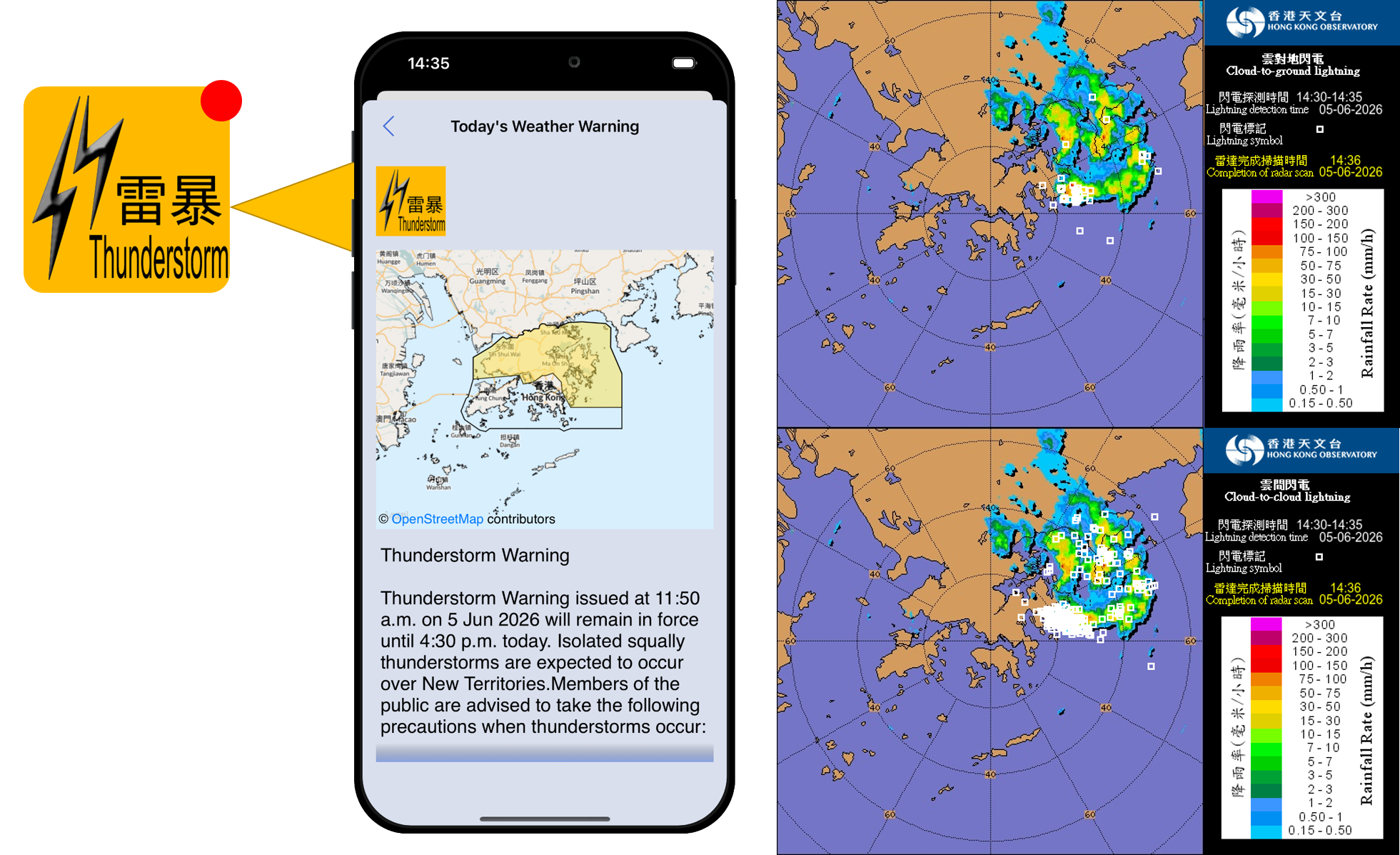
Figure 1. (Left) The MyObservatory app uses a red dot on the Thunderstorm Warning icon to indicate that the Thunderstorm Warning contains regional information; (Right) The radar and lightning image at around 2 pm on 5 June shows that lightning was affecting only the New Territories at that time.
Lightning Real-time Information and Nowcasting Products, with Case Studies
The Observatory's "Regional Information on Heavy Rain and Thunderstorm" webpage displays information of Thunderstorm Warning and dynamic lightning positions. Members of the public can also click on the map to select the location of interest in the "Location-specific Lightning Alert Webpage" and set alert ranges as needed. When lightning occurs within the designated alert range, the webpage will sound an alarm to alert. Regarding lightning nowcasting services, members of the public can refer to the "One-hour Lightning Nowcast" webpage or the "Location-based Rainfall and Lightning Forecast" function on MyObservatory to learn in advance about areas that may be affected by lightning.
Taking the thundery showers in the morning of 13 June 2026 as an example. As thunderstorms gradually approached Hong Kong, the Observatory issued the Thunderstorm Warning at 3:50 am that day, and by 4:30 am, lightnings already occured over Lantau Island. Subsequently, lightning was also recorded near Sha Tin at around 6:40 am, and the Observatory's "One-hour Lightning Nowcast" system had already forecasted that Sha Tin might be affected by lightning approximately 30 minutes in advance (Figure 2).
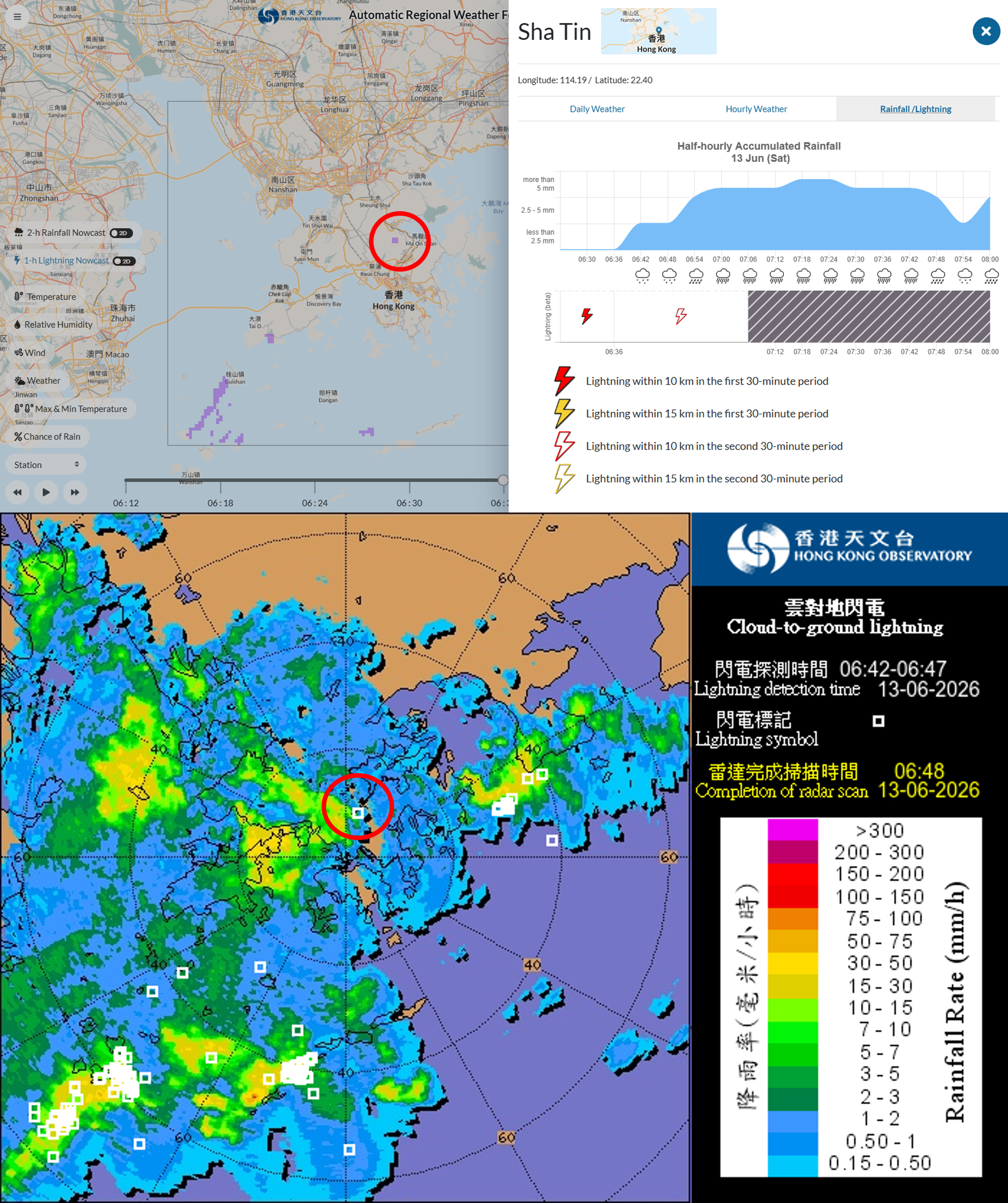
Figure 2. (Top) The "One-hour Lightning Nowcast" system at around 6 am on 13 June 2026 predicted that lightning would occur near Sha Tin at around 6:36 am. The purple squares on the lightning forecast map indicate the predicted lightning positions at the selected time; (Bottom) The Observatory recorded cloud-to-ground lightning over the area between 6:42 am and 6:47 am.
Summary and Advice
When the Thunderstorm Warning is in force, management staff and lifeguards at outdoor sports grounds, ball courts, swimming pools, or activity venues should monitor changes in weather conditions at all times, so as to provide appropriate guidance to venue users such as players and swimmers. The Observatory will also specify the areas affected by thunderstorms in the Thunderstorm Warning to remind members of the public to make appropriate arrangements and take precautionary measures. On the other hand, members of the public can obtain lightning information in advance through the aforementioned monitoring and nowcasting products. When thunderstorms occur, seek safe shelter immediate or as soon as possible if you are staying outdoors, leave the water and do not swim outdoors or engage in other outdoor water sports.