Meteorological instruments -- Temperature
Meteorological instruments -- Temperature
The following instruments and devices are used for measuring temperature:
| Instrument Diagram | Detailed Description |
|---|---|
|
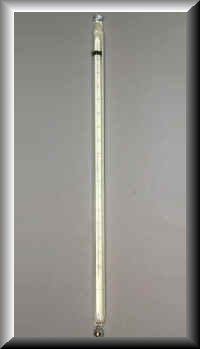
Liquid-in-Glass ThermometerLiquid-in-glass thermometer is a thermometer in which the thermally sensitive liquid is contained in a graduated glass envelope. The indication of such a thermometer depends upon the difference between the coefficients of thermal expansion of the liquid and the glass. For routine observations of air temperature, including maximum, minimum, dry-bulb and wet-bulb temperatures, liquid-in-glass thermometers are still commonly used. The liquid used depends on the required temperature range; mercury is generally used for temperatures above its freezing point (-38.8 degree Celsius), while ethyl alcohol or other pure organic liquids are used for lower temperatures. Mercury-in-glass type is usually used for meteorological purposes. |
|
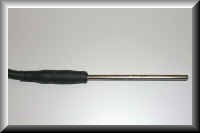
Electrical Resistance ThermometerA measurement of the electrical resistance of a material which varies in a known manner with the temperature of the material can be used to represent the temperature. Electrical resistance thermometers have the ability to provide an output signal suitable for use in remote indication and transmission of temperature data. They are widely used for measuring temperatures in meteorology especially in automatic weather stations. |
|
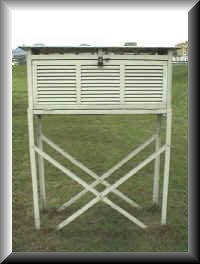
Stevenson ScreenStevenson Screen is an instrument shelter used to house the thermometers from exposure to direct sunshine and precipitation, while at the same time providing adequate ventilation. The screen has louvred wall to allow free circulation of air enabling the temperature inside the screen to equilibrate with the ambient temperature. |

|
Thermometer ShedThermometer Shed is a special shelter used in tropical regions to house the thermometers. A thermometer shed had been used at the Observatory Headquarters as early as the late 1880s. A comparison of temperature readings obtained by thermometers housed inside the shed and the Stevenson screen indicated that temperatures recorded at the shed were more representative of the ambient air temperature than those recorded inside the screen. However, due to the bulky size of a thermometer shed, Stevenson Screen is used at the automatic weather stations over Hong Kong. |
Definition of temperature
Temperature is the condition which determines the direction of the net flow of heat between two bodies. The body which overall loses heat to the other is said to be at the higher temperature.A thermometer is an instrument for measuring temperature by utilizing the variation of the physical properties of substances according to their thermal states.
Meteorological requirements
Temperature measurements are required, for weather analysis and prediction, hydrological and agricultural application, and for climate studies.For general meteorological work, the observed temperature should be representative of the free air conditions surrounding the station over as large an area as possible, at a height of between 1.25 and 2 m above ground level. In order to ensure that a thermometer is at true air temperature, it is necessary to protect it from solar radiation by a screen or shed which also serves to support the thermometer. This screen also shelters it from precipitation while allowing the free circulation of air around it, and prevents accidental damage.
Units of measurement
- Kelvin (K)
- degree Celsius (°C)
- degree Fahrenheit (°F)
Equations for the conversion of temperature readings among K, °C and °F are︰
c = k - 273.16
c = (f - 32) × 5/9
f = c × 9/5 + 32
- k is temperature reading in K
- c is temperature reading in °C
- f is temperature reading in °F