Location-specific Automatic Weather Forecast using AI Weather Model
Location-specific Automatic Weather Forecast using AI Weather Model
CHOW Wang
December 2025
Using the "Hong Kong and Pearl River Delta Automatic Regional Weather Forecast" website or the "MyObservatory" app, members of the public can access detailed location-specific automatic weather forecasts for the next hour up to nine days ahead anytime and anywhere, making it easier to get hold of weather changes and to plan daily activities. This forecasting system integrates predictions from various global Numerical Weather Prediction (NWP) models. In general, the NWP models utilize meteorological observation data to analyse the current weather condition, then generate weather forecasts by making use of atmospheric physical equations. However, the direct output of NWP model has limitations [1] and still deviates from actual observational values. To improve the accuracy of prediction and to achieve refined location-specific weather forecasts, model post-processing method is applied to adjust the direct output of the NWP models using real-time observational data collected from the Hong Kong and Pearl River Delta region. They are then combined based on weightings derived from their past performance to generate the automatic regional weather forecast products. This Objective Consensus Forecast (OCF) system effectively reduces the errors found in the direct output of NWP models [2].
In recent years, artificial intelligence weather models (hereafter referred as AI models) have shown impressive performance in the field of meteorological forecasting [3, 4]. They not only excel at predicting tropical cyclone tracks, but also capture weather changes due to large‑scale circulation systems more effectively, giving them an advantage over traditional NWP models. Currently, AI models typically have a coarser spatial resolution than NWP models. Can AI models still demonstrate their advantages when applying their data products in location-specific weather forecasts?
To investigate this issue, we recently applied the aforementioned post-processing technique to AI models, including the “European Centre for Medium-Range Weather Forecast’s AI Integrated Forecasting System (AIFS)”, “Fengwu”, “Fuxi” and “Pangu” to adjust their forecasts. Combining the performance of the post-processed forecasts of the above four models, the preliminary results show that the AI model reduces the error by around 3 % to 16 % over the current OCF in forecasting daily minimum temperature of the Hong Kong Observatory over the next nine days (Figure 1). Regarding daily maximum temperature forecast, the AI model reduces the forecast error by about 10 % on average for the next day 2 to day 5 (Figure 2). However, the AI model’s prediction errors are slightly worse than those of the current OCF thereafter, with the forecast errors in days 8 and 9 increased by roughly 10%.
Based on these findings, we have integrated the post-processed forecasts from the above AI models into the existing OCF system. As shown in Figures 1 and 2, this “Enhanced OCF” successfully leverages the strengths of both NWP and AI model forecasts, providing a more accurate reference on the daily maximum and minimum temperature predictions. In the process of combining multiple NWP and AI model forecasts, the model post-processing adjusts the weightings of each model’s forecasts in computing the “Enhanced OCF” result based on the forecast errors of the individual NWP and AI models. This allows the “Enhanced OCF” to effectively prioritize the contribution of the better-performing NWP or AI models in the multi-model ensemble. Figures 1 and 2 indicate that the Enhanced OCF reduces error in daily minimum temperature forecasts over the next nine days by about 10% on average, while also improving the accuracy of daily maximum temperature forecasts when compared to the current OCF.
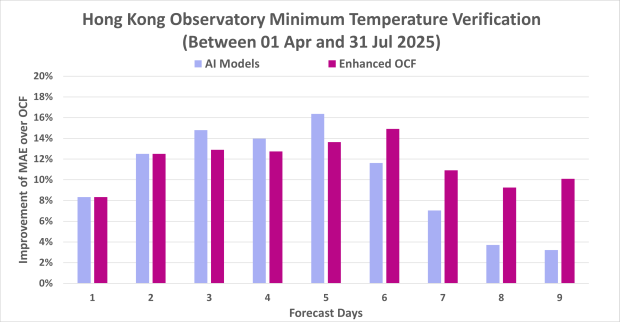
Figure 1 Percentage of improvement (in terms of reduction in mean absolute error) in daily minimum temperature forecasts (April–July 2025) compared to the current OCF.
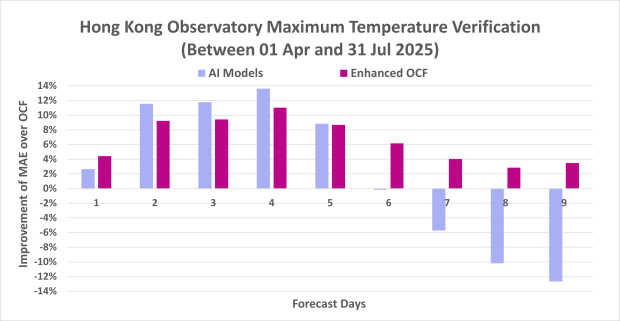
Figure 2 Percentage improvement in daily maximum temperature forecasts (April–July 2025) compared to the current OCF.
Using the forecast on the 17 May 2025 as an example, while temperatures are quite affected by cloud amount, rainfall, wind direction and wind speed during the transition from spring to summer, the Enhanced OCF still delivers temperature prediction for the Hong Kong Observatory closer to the actual observations as compared to the current OCF (Figure 3).
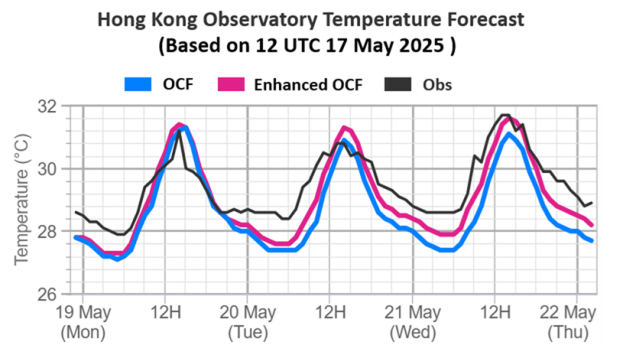
Figure 3 Hong Kong Observatory hourly temperature forecast and observations.
Meanwhile, it is important to emphasize that neither the direct output of traditional NWP nor AI models, or even their post-processed products, can fully replace the expert judgements of forecasters regarding the various weather elements. Here are a few key reasons:
- Real-world experience with complex weather systems: Forecasters draw on their knowledge of actual conditions and historical cases to refine predictions for complex phenomena such as tropical cyclones, severe thunderstorms, and terrain-induced effects.
- Managing uncertainty: AI model can process massive amounts of data, but its ability to explain the sources of forecast errors remains rather limited.
- Real-time decision adjustments: In face of sudden weather changes such as rapid development of thunderstorms, forecasters can quickly update the weather forecast based on the latest observation data.
- Real-world experience with complex weather systems: Forecasters draw on their knowledge of actual conditions and historical cases to refine predictions for complex phenomena such as tropical cyclones, severe thunderstorms, and terrain-induced effects.
- Managing uncertainty: AI model can process massive amounts of data, but its ability to explain the sources of forecast errors remains rather limited.
- Real-time decision adjustments: In face of sudden weather changes such as rapid development of thunderstorms, forecasters can quickly update the weather forecast based on the latest observation data.
Nonetheless, the initial findings of the "Enhanced OCF" above offer valuable guidance for developing the next generation of the Hong Kong and Pearl River Delta Automatic Regional Weather Forecast service. They also provide a technical foundation for the provision of more accurate location-specific automatic weather forecasts using AI models in the future.